
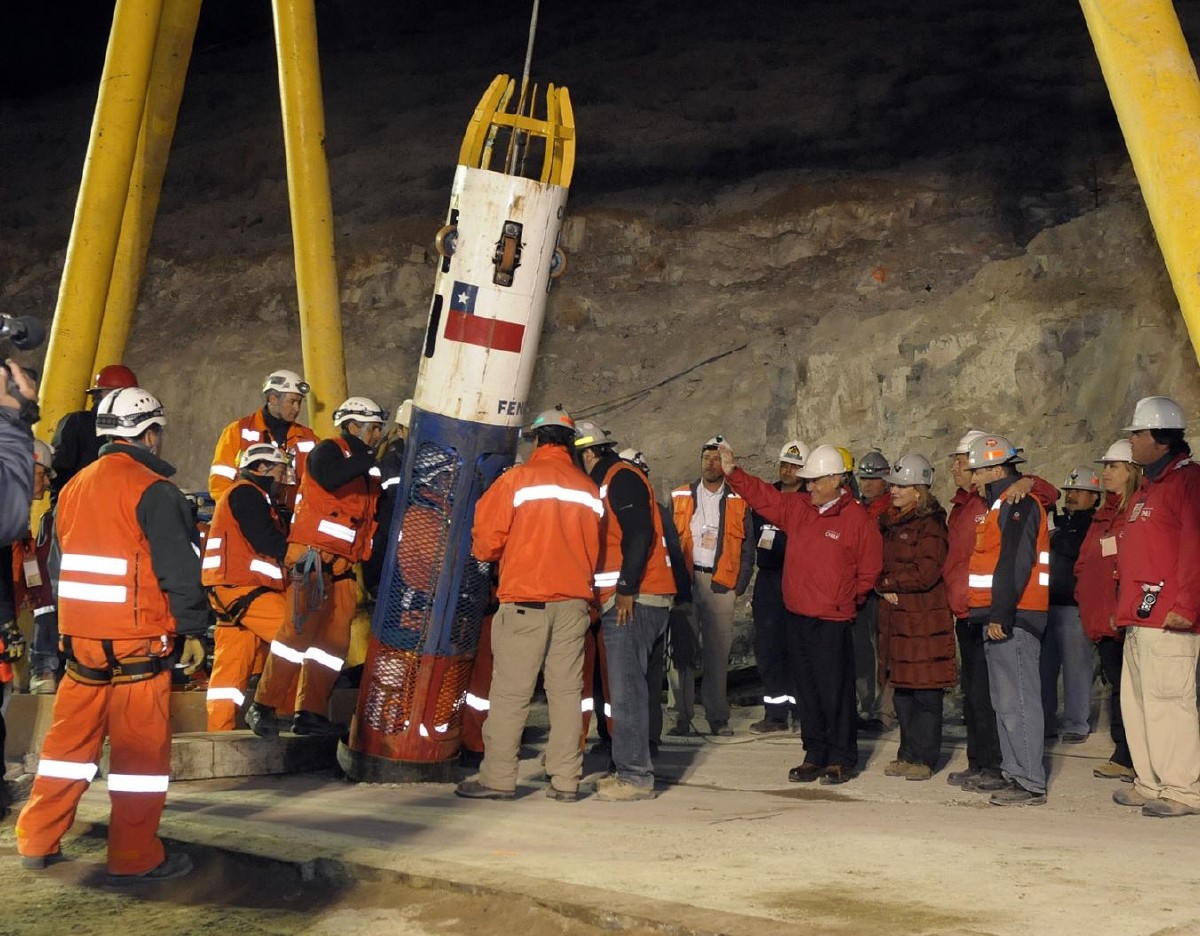
A lesson from 700 meters underground
In 2010, 33 miners were trapped underground in Chile. They survived for 69 days until they were rescued with surgical precision. What saved them wasn’t improvisation or spontaneous creativity. It was decades of accumulated knowledge: rock mechanics, statistical probability, materials engineering, behavioral psychology, human physiology, communication systems. The Phoenix capsule that brought them back to the surface one by one was not born from intuition : it was the result of theory applied with expertise.
This story isn’t about mining. It’s about the value of depth. And it serves as a warning for the field of design, which in recent decades has gradually removed theory from its curricula under the pretext of making them more “dynamic,” “practical,” or “market-oriented.”
While Chilean engineers rigorously applied scientific knowledge to save lives, many design schools were discarding subjects like visual perception, semiotics, visual anthropology, or systems theory, labeling them as “too dense,” “unappealing,” or “not directly applicable.” In the process, speed was mistaken for skill, intuition for quality, practice for absence of reflection.
The core mistake: turning theory into creativity’s enemy
The opposition between theory and practice is a false dichotomy. Practice without theory is just repetition. Theory without practice is mere speculation. Designers shouldn’t be forced to choose one over the other : they should be trained to move fluently between both.
Yet the prevailing discourse promotes a dangerous simplification: that theory stifles creativity, or worse, that it’s unnecessary. This narrative has shaped generations of designers who can’t explain why a solution works, who don’t understand the cognitive processes involved in reading an image, and who lack foundational knowledge of visual attention and memory.
The endless reinvention of the wheel
If the Chilean engineers had ignored decades of accumulated knowledge and started from scratch with open ideation sessions, the miners might still be underground. In design, however, that kind of posture (ignoring theory and history) has become normalized. Every new generation believes it’s discovering something new, often just repeating older, less informed variations of existing solutions.
The difference? Design doesn’t deal with rock collapses, but it does deal with decisions that affect behavior, comprehension, access to information, safety, inclusion. And often, these decisions are based not on consolidated knowledge, but on aesthetic preferences or popular tools.
The consequences of superficiality
-
Designers who can’t justify their work
Lacking a theoretical foundation, arguments like “the client liked it” or “it looks nice” take the place of informed reasoning. The ability to explain and defend decisions with consistency and responsibility disappears.
-
Repetition of avoidable mistakes
Without knowledge of how the brain perceives and processes visual input, designers ignore basic principles of cognition, such as cognitive load, visual hierarchy, or pre-attentive processing.
-
Vulnerability to trends
Without theoretical criteria, every new fad seems valuable. Designers start making decisions based on what’s trending rather than what’s appropriate. The result is shallow, short-lived work.
-
Devaluation of the profession
When design is seen as a set of easily replicable techniques, anyone with access to templates and a weekend workshop believes they can do it. The field loses rigor, and with it, value.
What we’ve lost along the way
-
Cognitive psychology and visual perception
Understanding how the brain processes visual stimuli, how attention is distributed, what helps or hinders comprehension, these are essential for any designer. Ignoring them means designing in the dark.
-
Semiotics and visual communication
Every visual element communicates something. A button, a color, a typeface, all carry meaning. Designing without understanding these codes risks sending the wrong message, or no message at all.
-
Anthropology and cultural context
Designers create for people. People live in contexts. Without even basic knowledge of culture, symbols, habits, and social structures, design risks projecting false universals and excluding entire groups.
-
Systems theory
Every product, service, or interface is part of larger systems, economic, social, environmental. Ignoring these interdependencies leads to solutions that appear to solve one problem while creating ten others.
The path forward: reintegration, not regression
This isn’t about returning to a purely theoretical education disconnected from real-world application. It’s about rebuilding a lost balance:
-
Applied theory
Don’t just teach theory, show its power through real cases. Show how cognitive psychology informs layout decisions. How semiotics supports typographic choices. How anthropology prevents cultural blunders.
-
Reflective practice
Every project is an opportunity to think. Why this color? Why this flow? What does the user understand here? Designers must learn to think while making, not just after.
-
True interdisciplinarity
Design is not an island. It requires dialogue with neuroscience, sociology, economics, ecology. But meaningful dialogue requires shared language. Theory provides that language.
-
Valuing deep knowledge
Not all knowledge is light, fast, or fun. But deep knowledge is what sustains professional practice in critical situations. The rush to produce “market-ready professionals” cannot justify the abandonment of complexity.
Conclusion: design deserves more
The 33 miners were rescued because engineers didn’t improvise. They studied. They applied. They integrated disciplines. They designed based on accumulated knowledge.
Design deals with less dramatic but equally serious challenges: hospital signage that guides patients, digital navigation that provides access to public services, interfaces that help fight misinformation.
These challenges cannot be addressed with colorful post-its and motivational slogans. They require designers who can think systemically, apply theory wisely, and create with depth.
It’s time to bring the baby back. Not to replace practice, but to support it with something more solid than passing trends. Transformative design (design that protects, informs, or includes) demands more. It demands knowledge.