
Product development methodologies like the double and triple diamond have become industry staples, promising clarity and structure in complex design processes. The enhanced triple diamond model, which attempts to integrate product development with go-to-market strategies, represents the latest evolution of this thinking. However, despite their visual appeal and apparent logic, these frameworks often fail to capture the messy reality of how successful products are actually created. This article examines the fundamental limitations of diamond models and proposes a more realistic approach to understanding the creative chaos inherent in effective product development.
"The most innovative products emerge not from following neat diamond pathways, but from embracing the creative tension between disciplines and the nonlinear nature of discovery."
The myth of the methodical designer
Diamond models perpetuate the fiction that designers work in a methodical, sequential manner. They suggest a tidy progression from research to definition, ideation to prototyping, and development to delivery. This linear representation contradicts the reality experienced by practitioners, where insights might emerge during prototyping that send them back to research, or where implementation challenges force reconceptualization of the core idea.
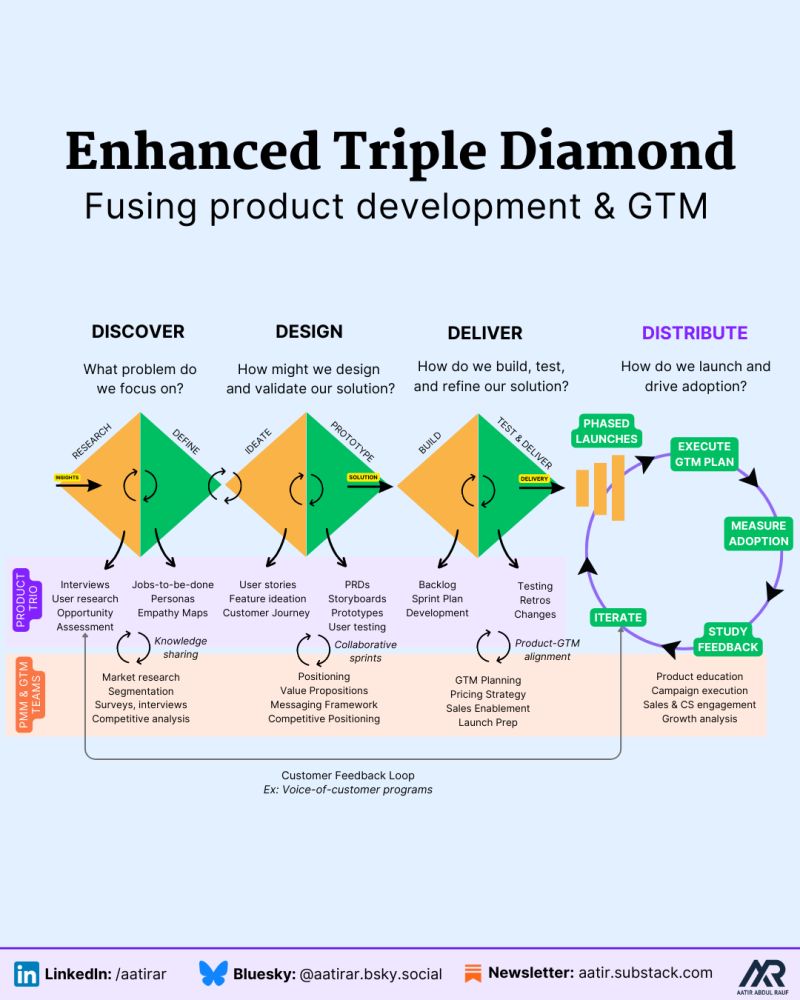
Designers rarely think in such compartmentalized ways. Creative breakthroughs often happen when boundaries between phases blur and when constraints from later phases inform earlier thinking. By artificially separating these processes, diamond models risk promoting a false understanding of how design innovation actually happens.
The waiting game fallacy
Another troubling assumption embedded in diamond models is that non-design professionals simply wait their turn, hands tied until designers deliver their wisdom in the form of requirements or prototypes. This perspective relegates engineers, marketers, and business strategists to passive recipients rather than active contributors to the solution space.
"Diamond frameworks often position designers as the heroes of product development, when in reality, successful products emerge from continuous collaboration across disciplines from day one."
In practice, the most effective product teams operate as integrated units where technology, market and user context are considered simultaneously rather than sequentially. Engineers may identify constraints that fundamentally shape what can be designed, while marketers might offer insights about user needs that designers hadn't considered.
The coadjutant syndrome
Diamond models typically present other disciplines as supporting actors in what is essentially a design-led process. Marketing, engineering, and business considerations are either tucked away as small components between major phases or introduced late in the process when key decisions have already been solidified.
This marginalization ignores how technical knowledge, business requirements, and market understanding should be deeply interwoven throughout the entire development process. When these perspectives are relegated to workshops or consultations rather than fully integrated into the core process, products risk becoming beautiful but unviable solutions.
The illusion of clean transitions
Perhaps most deceptively, diamond models suggest clean transitions between phases, with clear deliverables passed like batons in a relay race. In reality, product development rarely experiences such discrete handoffs. Features may be in different stages simultaneously, with some components in discovery while others are being refined or distributed.
"The modern product development process isn't a relay race with clean handoffs; it's more like a dance where partners continuously adjust to each other's movements."
This oversimplification obscures the messy reality of product development, where teams constantly shuttle between discovery, definition, development, and distribution as new information emerges and understanding evolves.
The reality of continuous collaboration
True product development is characterized by continuous collaboration, with various stakeholders involved throughout the journey. Developers don't simply wait for designers to hand off specifications; they collaborate on exploring technical possibilities. Marketers don't merely execute distribution plans after products are built; they help shape the product vision from the earliest stages.
These continuous collaborative loops create an environment where ideas are constantly tested against technical, business, and user realities. The boundaries between phases become permeable, and the entire team shares ownership of both problems and solutions.
Embracing creative chaos
Rather than fighting against the inherently messy nature of innovation, successful teams learn to embrace a certain degree of creative chaos. They recognize that breakthroughs often happen at the intersections between disciplines and that maintaining rigid phase-based thinking can stifle the very creativity they seek to foster.

"Trying to force product development into diamond-shaped containers is like trying to map a forest with straight lines – you might create a neat diagram, but you'll miss the organic reality of how things grow."
This doesn't mean abandoning all structure, but rather adopting frameworks that acknowledge the interconnected, iterative reality of product development while still providing enough guidance to prevent teams from spinning in circles.
Conclusion
While diamond models offer an attractive simplicity, they ultimately present a distorted view of product development that can lead teams astray. By acknowledging the non-linear nature of innovation, the continuous collaboration across disciplines, and the complex interdependencies between discovery, design, development, and distribution, teams can develop more realistic approaches that embrace rather than deny the creative chaos inherent in building great products.
The next generation of product development frameworks needs to represent the messy reality of successful innovation – not as a failing to be corrected, but as a strength to be harnessed. Only by moving beyond the diamond delusion can teams fully leverage the power of truly collaborative, integrated product development.