
Service design has lost precision as it has come to name almost any activity: research, a workshop, a journey map, an interface improvement, or a conversation about strategy. A concept that explains everything, however, stops explaining anything. A useful definition must therefore say not only what belongs to the field, but also what falls outside it.
A definition based on decisions
Service design is the practice of improving decisions about how the parts of a system—people, processes, rules, channels, technologies, and partners—combine to produce or undermine outcomes for those who use and operate a service.
This definition does not depend on a job title, template, or deliverable. It points to the kind of decision at stake. A map can help reveal these relationships, but making a map does not automatically make the work service design.
A service is not a finished artifact
A chair or a poster can reach a final form relatively controlled by its designer. A service cannot. It unfolds over time and is co-produced by people who will never be entirely under the designer’s control: customers interpret instructions, employees improvise, systems fail, rules conflict, and unexpected situations arise.
That is why professionals do not deliver “the service” as if it were a finished object. They design conditions: roles, sequences, rules, resources, environments, information, decision-making arrangements, and recovery mechanisms. These conditions make good service encounters more likely and poor ones less likely. Reality, however, always has the final say.
This is also why “designing services” is more accurate than simply “drawing services.” A drawing can represent an intention; a design must turn that intention into conditions that survive contact with operations.
The stage and everything that sustains it
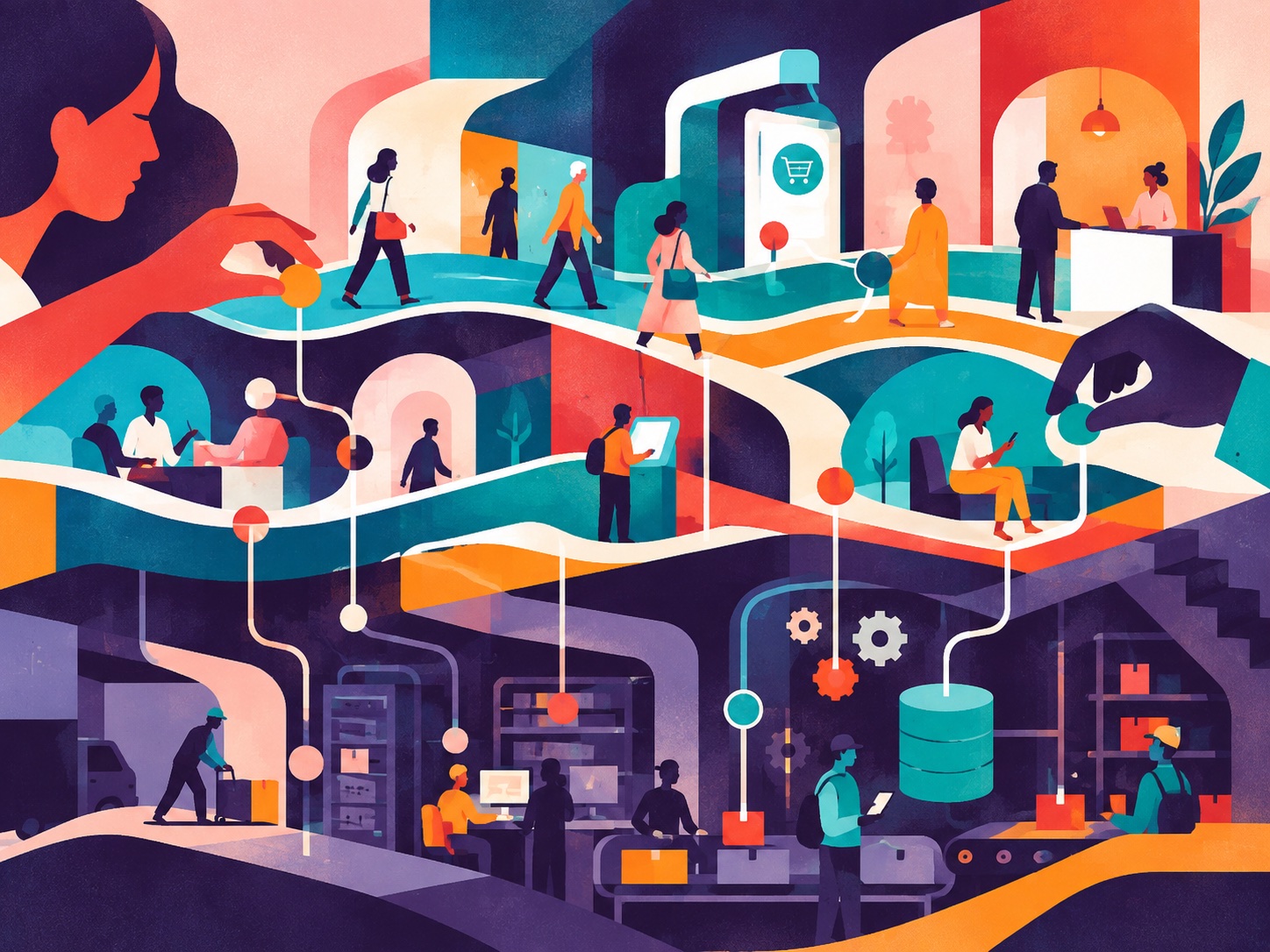
People using a service see only part of it: a screen, an employee, a store, a message, a delivery. This is the frontstage. That encounter depends on a backstage of people, systems, suppliers, data, policies, decisions, and handoffs between teams.
Service design works with the relationships among these parts. An interface can be impeccable and still lead to a poor service if the marketing promise, operational capacity, and support response contradict one another. The symptom appears on the screen; the cause may lie in a target, rule, or invisible queue created weeks earlier.
What service design is not
Some boundaries help restore the concept’s usefulness:
- Changing a button’s color is not service design. It may be an important interface decision, but it does not change the service system.
- Running a workshop is not service design. If nothing changes in processes, rules, responsibilities, or delivery conditions, there was a conversation—not a service transformation.
- Drawing a map without data is not service design. It is an illustration of the team’s opinion.
- Applying a tool in isolation is not enough. Blueprints, journeys, and prototypes are ways to investigate and decide, not proof that work belongs to the field.
- Saying everything is a service does not mean everything is service design. The field needs boundaries to remain explainable and assessable.
Where the value lies
Value does not live inside a deliverable. It appears when something important can flow through the system: a person resolves what they needed, an employee can work without relying on heroics, the organization delivers with less waste, and relationships among the parts become sustainable.
Often that value already exists but is blocked by bureaucracy, silos, contradictory rules, disconnected systems, confusing communication, or metrics that reward the wrong behavior. The work is not to “create delight” on top of a defective structure. It is to find where value is stuck and test a better configuration for the system.
Who can do this work
Problems do not arrive with a label telling us which profession owns them. People in product, UX, operations, research, technology, or support can develop a deep perspective on services. Likewise, someone with the title service designer can produce shallow work.
The field’s contribution is not exclusive ownership of certain problems. It is a way of seeing relationships, dependencies, exchanges, and invisible structures. The meaningful difference is not between those who “have the title” and those who use a tool. It is between looking only at the touchpoint and understanding the system that produces it.
How to recognize serious work
A service design project should be able to show:
- which outcome needs to change for users and operators;
- which evidence supports the diagnosis, rather than relying only on internal opinions;
- which system relationships produce the current problem;
- which decisions will change—processes, rules, roles, channels, or technology;
- how the new configuration will be tested in real operations;
- how we will know whether the system improved, including when exceptions arise.
Without these elements, a project risks producing a beautiful representation of the problem while leaving the problem intact.
Continue with service design principles, compare the field with UX and CX, or return to the foundations guide.
Perguntas frequentes
What is service design, in a few words?
It is the practice of improving decisions about how people, processes, rules, channels, systems, and partners combine to produce outcomes for both service users and operators.
How is service design different from UX?
UX often improves use interactions and tasks; service design also works with the operational relationships, rules, and dependencies that make those interactions possible across a service.
Is service design the same as design thinking?
No. Empathy, collaboration, and experimentation are not exclusive to design thinking. Services also require working with multiple actors, conflicting interests, operations, variability, and implementation.
Do I need to code or draw to work in service design?
No. What matters is investigating the real service, understanding systemic relationships, and helping different teams make better decisions. Maps and prototypes are means, not the profession itself.